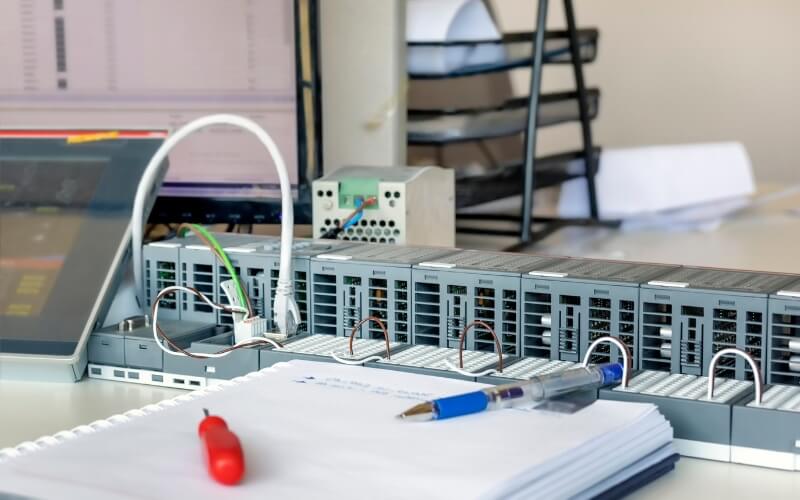
PLC stands for Programmable Logic Controller. A PLC is an industrial computer that processes signals from sensors and controls actuators based on pre-programmed rules, thereby automating production and manufacturing processes.
Within a dynamic company, this building block ensures the logical control of machines. Connected sensors and external control systems work together with the central processing unit to make decisions based on predefined rules. This gives you insight into your processes, increases productivity, and reduces maintenance costs.
Table of Contents
What does PLC stand for?
PLC is the abbreviation for Programmable Logic Controller. In Dutch, it is called a “programmeerbare logische besturing,” and that name describes exactly what the device does: a control system whose logic is programmable rather than hardwired.
That distinction is at the heart of the technology. In a traditional relay control system, the logic is embedded in the wiring itself. If you want to change the machine’s behavior, you have to open the control cabinet and rewire it. With a PLC control system, that logic is embedded in software. An adjustment then involves a program change, not a wiring job.
In practice, the terms “PLC,” “PLC control,” and “control technology” are used interchangeably. They all refer to the same thing: the programmable core of an industrial control system.
The History of PLC Control
In the 1960s, companies were looking for a more efficient and flexible way to control machines logically. At General Motors, they were hampered by relay cabinets that had to be rewired for every new model year. These cabinets used push buttons, indicator lights, timers, and circuits such as the star-delta circuit. Reliable, but inflexible: every change meant redesigning and rewiring.
In 1968, Richard “Dick” Morley developed the first programmable controller as a solution to that problem. The result was the Modicon 084, where Modicon stands for Modular Digital Controller. The programmable electrical controller thus became the alternative to traditional relay-based systems. Since then, PLCs have played a key role in the advancement of industrial automation.
Over time, PLCs have become increasingly sophisticated and are available in many different models. This has been accompanied by improved processors, greater memory capacity, and more extensive communication capabilities. All in all, this enables a wider range of applications, such as the control of production lines, packaging and sorting machines, and the automation of buildings and infrastructure.
Modern programmable logic controllers offer features such as real-time data analysis, integrated safety systems, and connectivity with other industrial systems via the Internet of Things. This allows you to simplify your automation processes and monitor them more effectively.
How a PLC Control System Works
The Components of a PLC Control System
A PLC control system consists of a number of components that, together, enable the automation of a process.
- Processor (CPU): the core of the control system. The processor executes the programmed logic.
- Memory: This is where the program, process information, and intermediate results are stored.
- Inputs and outputs (I/O): These connect the control system to external sensors and actuators that send and receive signals. A distinction is made between digital cards for on/off signals, analog cards for measured values such as temperature or pressure, and Remote I/O for a decentralized configuration in which the modules are located close to the process.
- Power supply: This ensures that the control system has the required power.
- Communication interface: This allows the control system to communicate with other systems, including monitoring and control systems.
- Control panel: the interface between the operator and the control system. It provides access to controls and data.
Together, these components form an effective and versatile system capable of automating and monitoring processes. This allows you to better manage your production procedures.
From Sensor to Actuator
A PLC control system enables efficient and precise automation of complex installations through a combination of hardware and software. The hardware includes the sensors, the actuators, and the PLC itself, all of which are connected to the process. The software consists of the rules and algorithms that the controller uses to analyze incoming data and determine how the process should be controlled. Commands are then sent to the actuators that actually control the process.
That sequence repeats continuously: read, process, output, and start over. This scan cycle has a predictable turnaround time, and that is exactly what makes a PLC deterministic. It’s also the reason a PLC is used in industry and a regular PC isn’t: not because it’s faster, but because you know exactly how long it takes.
Configure and Customize
You can configure a PLC control system to meet the needs of your production process. This can be done by modifying existing programs or by integrating new components and sensors. Examples include sensors for humidity, pressure, or temperature, so that the control system can monitor and analyze that data. By adding graphical displays, push buttons, and other control components, you can also improve the user interface.
That adaptability is why a PLC control system can meet a wide range of requirements. If you’re looking for an automated solution that’s both flexible and powerful, a PLC control system is the way to go. Kwadrant IA designs and programs PLC systems that are tailored to the specific installation in which they operate.
OPEN CALCULATION
OFFER IN 5 DAYS
SUSTAINABLE INNOVATIONS
UL/CSA
IN HOUSE
Where PLC Control Is Used
PLC control has a wide range of applications, from factory production lines to transportation systems and infrastructure. In the manufacturing industry, PLCs help automate the control of production steps, leading to greater efficiency and productivity. This technology is also used in the transportation sector, for example, to control trains and traffic lights. In the energy sector, PLC control contributes to the automation and monitoring of processes. This versatile technology is therefore useful in many industries.
In practice, you’ll find PLC-controlled machines in a variety of settings, including:
- Production lines and packaging machines for the food, pharmaceutical, and packaging industries
- Conveyor Systems and Internal Logistics
- Lock control, pumping stations, and water treatment in water management and infrastructure, such as our PLC control systems for water treatment plants
- Tank Control and Dosing Processes in the Process Industry
- Robot cells and automated production lines
The Benefits of PLC Control
A control system using a programmable logic controller has several advantages over traditional control systems.
- Flexibility: PLCs can be programmed to control a wide variety of processes and can be adapted to changing production requirements.
- Monitoring and analysis: PLCs enable real-time monitoring and analysis of production processes, allowing potential problems to be identified early so you can address them proactively.
- Safety: PLCs support advanced safety systems, including emergency stops and safety relays. These reduce the risk of accidents and ensure a safe state in the event of a malfunction. Learn more about our approach to machine safety.
- Cost-effectiveness: The use of PLCs is generally more cost-effective than traditional control systems because they require little maintenance and are less prone to malfunctions.
PLC control thus offers powerful and versatile solutions for automation and monitoring, which can lead to higher productivity, efficiency, safety, and controllability.
Contact our experienced innovator
Cees Brasser
With more than 26 years of experience at the helm of Kwadrant IA, Cees Brasser is your expert on panel construction for the mechanical engineering sector. Discover how his knowledge and insight can take your project to new heights. Get in touch now!
Maintenance and Service Life
To ensure a reliable and efficient production process, it is important to extend the service life of your PLC control system. The following tips will help you do that.
- Perform regular maintenance. Regular checks for software updates, malfunctions, and system diagnostics prevent problems before they cause a loss of production.
- Protect from dust and moisture. Keep the control unit away from dust and moisture. A dust cover or an enclosure with an appropriate IP rating provides additional protection.
- Avoid overexertion. Overloading causes premature aging and damage. Please adhere to the recommended load limits.
- Use high-quality components. High-quality safety relays and current protection devices extend the service life of the entire system.
The PLC is at the heart of many modern production lines and machine parks and plays a key role in determining performance and product quality. Maintenance is therefore not a minor matter: it is what determines the availability of your system.
Kwadrant IA designs, programs, and maintains PLC systems for machines and installations, from functional design through commissioning. Would you like to know what’s possible in your situation? Schedule a technical consultation.
Your electrical engineering ambitions, our mission
Our expert team at Kwadrant IA is ready to turn your electrical issues into concrete solutions. Are you ready for the next step?
Frequently Asked Questions About PLC Systems
What does PLC stand for?
PLC stands for Programmable Logic Controller. It is an industrial computer that controls machines and processes using software rather than hardwiring.
What does a PLC control system do?
A PLC control system reads signals from sensors, processes them according to the programmed sequence, and then controls actuators. This cycle repeats continuously with a predictable cycle time, making the control system deterministic and reliable.
What does a PLC control system consist of?
It consists of a processor, memory, input and output modules, a power supply, and a communication interface. In addition, it usually includes a control panel or HMI for operating the system and displaying process data.
What is the difference between a PLC and a relay-based control system?
With relay-based control, the logic is embedded in the wiring, which means that any change in behavior requires rewiring. With a PLC, the logic is embedded in software, and a change simply involves modifying the program. This makes a PLC more flexible, more compact, and easier to maintain.
What is the difference between a PLC and a SCADA system?
The PLC directly controls the process. A SCADA system is the higher-level layer that collects, visualizes, and records data from PLCs. Read the detailed comparison between SCADA and PLC.
How long does a PLC control system last?
With regular maintenance, protection against dust and moisture, and adherence to load limits, a PLC control system will last for many years. Its practical service life is more often determined by the availability of parts and support than by wear and tear on the control system itself.
Related Articles

Modbus, Profinet or Profibus? Industrial communication protocols compared
Modbus, Profinet and Profibus are three widely used industrial communication protocols, each with its own role. Modbus is a simple, vendor-neutral protocol for sensors, meters

What is a SCADA system and how does it compare to a PLC?
A Supervisory Control and Data Acquisition (SCADA) system is software that allows operators to centrally monitor and control industrial processes. It collects real-time data from
IP65 ventilation problem in control cabinets
An IP65 control cabinet is chosen to protect components from dust and water. This is important in industrial environments, production areas, outdoor setups or installations
When do you need cooling in a control cabinet?
A control cabinet always develops heat. That happens from components such as power supplies, PLCs, variable speed drives, relays, contactors, network components and cabling. In
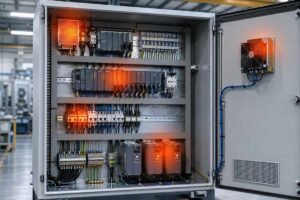
5 causes of overheating in electrical cabinets
A control cabinet that gets too hot has usually been giving signals for some time. An inverter occasionally fails. A power supply gets hotter than
ATEX zone 1 vs. zone 2: what does it mean for your control cabinet?
Within industrial environments where explosion hazards are present, ATEX zones are often used. Yet in practice we see that the difference between zone 1 and